New Delhi, March 2026
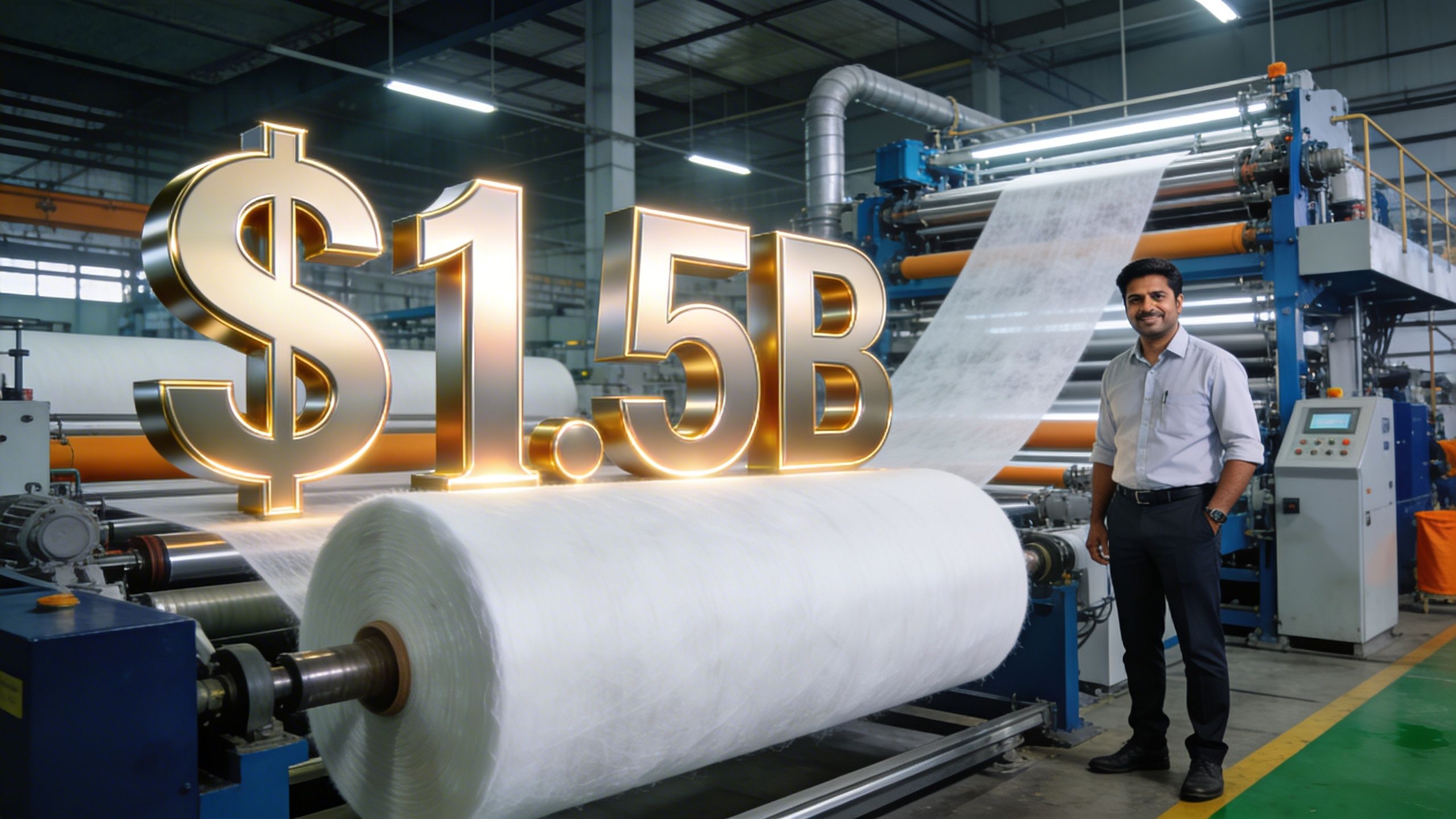
India's nonwoven fabrics market generated $1.5 billion in revenue in 2024 and is on track to reach $2.3 billion by 2030, according to Grand View Research. The sector is growing at a compound annual rate of 7.6 percent, outpacing the broader textile industry. What is driving that growth is not a single product category but a convergence of demand from hygiene, healthcare, automotive, filtration, and infrastructure, all pulling in the same direction at the same time.
India is already the second-largest nonwoven producer in Asia after China. Production capacity climbed from 253,000 tonnes in 2013 to 514,000 tonnes by 2020, according to data from the Gujarat government's textile division. The numbers have continued to climb since, though precise post-pandemic figures are harder to pin down. What is clear is that domestic consumption has expanded rapidly, driven by disposable hygiene products like baby diapers, feminine care, and adult incontinence pads.
Demand Beyond Hygiene
But the hygiene segment is only one piece. Geotextiles for road construction and embankment stabilization have become a significant demand driver as India's infrastructure spending accelerates. Filtration media for air and water purification is another fast-growing application, particularly after the pandemic heightened awareness around indoor air quality. Automotive interiors use nonwoven components for insulation, carpet backing, and headliners. Each of these applications requires different fibre blends, web-forming techniques, and bonding processes.
Equipment Choices Define Market Access
That complexity is where equipment choice matters. A nonwoven line built for hygiene spunbond is not the same as one designed for needle-punched geotextiles or thermally bonded wadding for home furnishing. Italian manufacturer FKgroup, which specializes in complete nonwoven production lines covering fibre opening, carding, cross-lapping, needle punching, and thermal bonding, has seen growing traction in India. Magnum Resources, which handles FKgroup's distribution in the country, notes that the enquiries have shifted. Two years ago, most interest came from hygiene producers. Now, automotive and filtration manufacturers are asking the same questions.
Policy Support and Industry Events
The policy environment is helping. The government's National Technical Textiles Mission, launched with an outlay of Rs 1,480 crore, specifically targets nonwovens as a growth category. PM MITRA parks, designed as integrated textile manufacturing zones, are expected to attract nonwoven producers alongside conventional textile units. India ITME 2026, scheduled for December 4 to 9 at IEML in Greater Noida, will feature technical textiles as a major exhibition category. The show expects over 1,800 exhibitors and 150,000 visitors.
Closing the Import Gap
One barrier to faster growth is India's dependence on imported nonwoven products at the higher end. The country is a net exporter by volume but still imports specialized, higher-value nonwovens from technologically advanced economies. Closing that gap means investing in production lines that can handle finer fibre blends, maintain tighter tolerances, and run at speeds that justify the capital outlay. For manufacturers in Gujarat, Maharashtra, and Tamil Nadu who are evaluating new capacity, the machinery decision is not just about throughput. It is about which product categories they can enter.
India's nonwoven sector has moved past the early growth phase where simply adding capacity was enough. The next stage will be defined by product mix, process control, and the ability to serve applications that demand consistency at scale. Manufacturers who get the equipment decision right will capture a share of a market that is adding roughly $130 million in new revenue every year. Those who buy the wrong line will spend years trying to pivot.